(1) Planning your questions - the problem solving aspect of the assessment
(2) Writing your questions - A knowledge aspect
(3) Answering your questions - A knowledge/Investigation aspect
You need to get (1) done ASAP. If this is done the rest, with time, will take care of itself.
The video below is a guide to planning your questions.
SUPER BONUS 2-WEEKS-OUT EXTRA TIPS 924 – GALVANIC CELLS Q1) 2 marks Oxidation # and oxidant/reductant Q Q2) 3 marks Metal displacement and activity series Q Q3) 3 marks – must relate to an experiment Q about Expt (#7) (Eg could be about: errors, equipment, method, explanation of different V, safety etc) Q4) 4 marks Explanation of requirements /process of a galvanic cell – could have diagram stimulus? Q5) 5 marks – must be a question where the answer needs to include a diagram Drawing, labelling and making calculations about a specific galvanic cell Q6) 6 marks – must relate to applications of chemistry Dry/silver cell Q
SUPER BONUS WEEK 3 EXTRA TIPS
Getting ready to study for the quiz?
Study notes finished and practise Q started but just want a quick recap of the big ideas?
Want to make sure you know all the important concepts?
Then check out these revision videos (made for the class of 2013 during their HSC stuvac).
A lot of misconceptions and ugly Chemistry appeared in this set of activities. Most can be squashed pretty easily – but it is going to mean that you have to do some practise to get incorrect habits/thoughts out of your minds – if you made the same mistake 20 times in this activity it is going to take about that many correct attempts to purge your brain of that incorrect approach. You want to make sure that your exam-subconscious-autopilot-brain mode has the correct instructions hardwired in or else…
But before I look at the most troublesome questions here is myRant of the Week
1)Electrode potentials MUST include the unit VOLTS. Without Volts (or at least a capital V) the answer is meaningless. Don’t let all that hard work calculating the answer be worth nought because you forgot to add a V at the end of your answer.
2)Cu2+ and Cu+ are NOT the same thing. Use the correct cell potential!
Cu2+ + 2e-® Cu (s)Eo = 0.34V
Cu+ + e-® Cu (s)Eo = 0.52V
If you are ever doing a copper cell then it is mostly likely to be a 2+ solution and the reduction potential is 0.34V. Learn to love that number and learn to be wary of 0.52V.
3)We learn these things for a reason: OIL RIG, RED CAT, ANGRY OX, ABC’s. At the very least check what you have written against these rules. e.g. you have written a half equation where electrons are being lost then (OIL RIG) that means it is oxidation and (ANGRY OX) that means it is at the anode which is –ve.
4)USE THE REDUCTION POTENTIAL SHEET!. E.g., If you are told that there is a chlorine half cell then look at the data sheet to, not just figure out ABC’s but to also to figure out what reactions are possible. All of these examples below are wrong for many reasons, but that didn’t seem to stop anyone – you should be able to explain what is wrong with each one of these:
Cl2® Cl- + e-FAIL
½Cl2® Cl2 + e-WT FAIL
Cl- + e-® Cl2SO FAIL
Cl- + e-® Cl+SO VERY FAIL
Cl+ + e-® ½ Cl2FAIL
½ Cl2 + e-® Cl+EPIC FAIL
½ Cl2® Cl+ + e-FAIL
Q1) The dry cell is also known as the Leclanche cell (after the inventor of one of the first dry cell batteries). It is non rechargeable. The Lead acid battery used in cars IS rechargeable
Q2) Just do it – people must have thought this was part of Q3 as many skipped it (and it was easy)
Q4) When converting from half equations to a full cell equation you must make the electrons balance before you add the half equations together. But when converting a full equation into half equations you should simplify the half cell equations at the end.
Q5,6, 7, 8) Main issue is reading the question and doing all the things the question asked.
Q6) So very bad – see Rant point #4 above. Also in shorthand notation it should go: ion|related gas,Pt
E.g. ||Cl- (aq)|Cl2(g),Pt
Q9) All pretty good except the overall cell equations. Just like any galvanic cell overall equation you: a) make the # of electrons the same in both half equations (i.e. for the dry cell you need to double that whole monkey-nuts equation)
b) simplify at the end (i.e. for the silver cell, the fact that electrolyte concentration stays the same means you should be able to cancel out the OH and H2O on both sides)
Q10) Just be careful - ‘ decreasing tendency’ means gong from the most likely to least likely
Q11) Similar to rant point 2 above. You need to be aware that there is a Fe2+/Fe half equation and a Fe2+/Fe3+ equations. Read the question carefully to know which one you need to use
Q13) To prove a reaction occurs ’as written’ means you need to prove the reaction is spontaneous. Spontaneous redox reactions give a positive Eo value. If you look at the equation provided, one reaction taking place is the oxidation of Iron(II) ions: Fe2+® Fe3+ + e-. Take out the Fe2+ and Fe3+ terms from the equation and you are left with the other half equation. That is on the data sheet too. Just add the Fe2+ oxidation Eo to the Eo of the reduction process and see if it is spontaneous.
Q14) First - figure out which is oxidised and which is reduced from the equation, then just add the two potentials together (remembering to reverse the sign of the oxidation Eo)
Compulsory activities – need to be done. What was done was done well except for-
Q2i) Draw the cell diagram needed to measure the Ti|Ti2+ cell potential. To measure a standard cell potential you need to connect it to the standard reference electrode. This is in your notes - you need to look up what the standard electrode is AND its conditions. Yes, technically you can figure out the Ti-cell potential by connecting it to Mg or Ni etc etc as some people drew– but you need to be able to explain the use (and draw a picture of) the standard reference electrode.
Summary feedback
A)We didn’t sand lead, we used a multimeter set to read voltage (not a voltmeter) & we used a new salt bridge for each new galvanic cell.
B)Explain means give a reason – so in the Chemistry context, that means give a reason based on some Chemistry concept. E.g. it is not good enough to say ‘The cell needed a salt bridge’. You need to say ‘The cell needed a salt bridge because...’ where you go on to give a reason based on chemistry.
C)While it is true that the greater difference in standard reduction potential, the greater the voltage (and you should say this) the Q refers you to the activity series so you should also relate the voltage to the relative reactivity of electrodes. Basically, the bigger difference in reactivity, the greater the difference in reduction potential and thus the greater the cell voltage.
D)Standard conditions are 25oC and 1mol/L solutions (and gases at 100kPa). If these conditions are not met the Eo values for the cells will be different to the data sheet and thus the cell potential (and possibly anode and cathode as different cells are effected differently by changing conditions) will be different to that predicted by the sheet. Corrosion or damage to the electrode surface can also change the transport of ions to the surface and effect Eo values.
E)You must mention storage (for proper disposal) all heavy metal solutions as part of your safety (i.e. do not tip down the sink)
F)Beware of the Cu+ vs Cu2+ problem identified above
G)Extracting data from graphs and tables is not just vital to extract data from standard potential tables to assess the validity of our experiment, it is also vital as that is how most numerical data is reported and scientists need to use this data to make calculations, judgements, conclusions and generalisations (i.e. about tends and patterns).
H)You need to calculate the theoretical voltages for your table, but take care with cell voltages to use the correct values. Also, the theoretical value should always be positive (i.e. the theoretical value is the voltage for the spontaneous reaction that should occur. Spontaneous reactions happen automatically without net energy input so their Eo will always be positive).
I)If you are gong to say ‘the salt bridge completes the circuit’ make sure you follow up with ‘by maintaining charge neutrality in the half cells’.
J)KISS – Keep it simple students. Answer the question and don’t over explain. Some of the explanations we use in class are gross-oversimplifications of very complex processes. I use these so that you get a better understanding of the basic process (so you will more easily comprehend & remember the theory) – but they aren’t so good in written reports. Eg for Q3c – just say ‘Anions migrate to the …. through the …. while cations….
K)In your results table, at minimum, you must include all the cells asterisked on the Excel table of result. Cu/Zn, Cu/Fe, Zn/Al, Al/Ni, Ni/Mg, Mg/Pb, Pb/Fe
L)Your cell diagram needs to have the full cell reaction, both half cell reactions, salt bridge, flow of electrons and ions labelled, +, -, all chemical species labelled AND label the anolyte and catholyte.
While I was marking the Experiment summaries I was imagining what an awesome game it would be if they made a Game of Thrones version of Kingdom Rush (a similar concept to the 'Rio' version of 'Angry Birds' but bout a trillion times cooler).
I then had to have a soundtrack for my marking - cue the Youtube hits below. Some people are very talented and have too much time on their hands.
If this does not send shiver down your spine then you need to a) stop what ever it is you are doing b) read 'A Game of Thrones' and/or c) Watch season 1 of the TV series d) come back here and watch this clip again to feel that sense of the awesome that sends a shiver down your spine
And to think that when I was younger I used to think that playing the violin was uncool. I was so naive in 2012
Hmmm, despite the fact that this performer has more talent than I can possibly imagine and despite the awesome choice of music, I'm still not convinced that the flute is cool - but seriously are these things even flutes?...
While the Piano Guys have the definitive Harry Potter and Pirates of the Caribbean performance, I'm still searching for the ultimate Piano of Thrones. This is one of the best I've heard so far
These next two blew me away. I wish I was cool enough to play a guitar.
I admire cellists ability to persevere with their instrument even while knowing that nothing played on a cello will ever surpass Cello Wars.
Well, these two instruments aren't really to my taste but it takes all kinds...
And the award for the most creepily awkward performance goes to...
And now to some Game of Thrones songs for your next birthday party, bucks or hens night or wedding
And then to the most coldest black-hearted song ever
And if you have seen the TV series you will probably find this funny (I did). If you haven't watched it- well, this clip won't make any sense and you will spoil the ending of season 1.
Actually I removed this because I thought about the content and then thought about who the audience is.
If you are determined to see it look up (and watch in this order, noting that they are major spoilers)
Hitler and Ned
Hitler and Khal Drogo
Hitler and Blackwater
The last one - even the name Hitler and... might be a spoiler
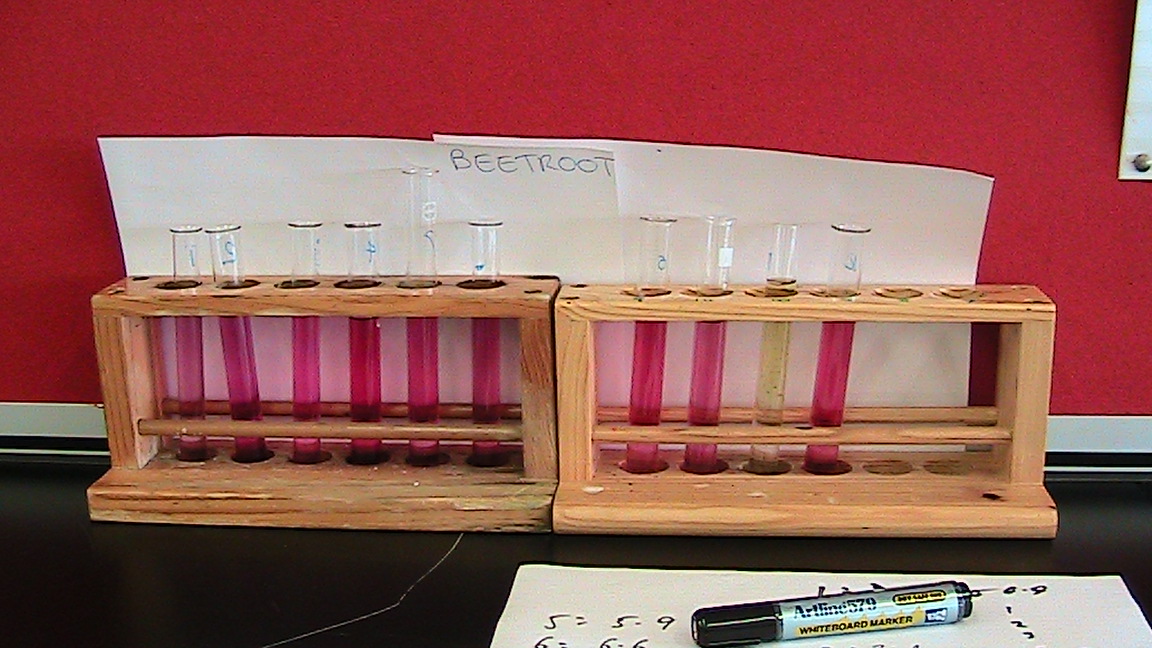
I did some testing after class and discovered that beakers 5-7 and 9-10 were a bit mixed up
Real pH (labelled pH)
0.9 (1)
2.1 (2)
3.4 (3)
4.2 (4)
4.6 (7)
5.4 (5)
6.7 (6)
7.8 (8)
10 (10)
12.1 (9)
So I re-ordered the test tubes to show lowest to highest pH and re-took the photos - shown below.
HINT - When assessing a natural indicator you have to ask - does it have distinct colour changes at certain pH's? Does the one colour give a consistent pH (or consecutive range of pH's)? Are the colours easy to interpret?
Hi - I've just finished checking and correcting (not marking) the notes you submitted for Part 2A. WOW - some very good ideas and a lot of hard work went into those notes. You should be proud. However, there were some frequent areas to improve and a few misconceptions. Your notes will be annotated to show which of these relate to you:
ai) (A) For all diagram of motors make sure you show the current flow in the coil and the correct direction of torque produced by the motor effect.
aii) (B) Make sure you say that because the current flows in opposite directions on either side of the coil the motor effect is in opposite directions on either side via the LHR, thus resulting in a torque about the axis.
(C) You need to relate the torque to the equation t = nBIAcosq and should note that momentum carries the coil past 90 degrees.
aiii) (D) Increased magnetic field strength can be achieved by increasing the stator magnet strength AND by using a laminated soft iron core. Also - don't say move the magnets closer together - moving them closer to the coil may work (but not as important as the other two mentioned) but suggests that you are going to decrease the size of the coil - which would actually decrease torque.
(E) To increase the current you can decrease the resistance of the coil or increase the supply voltage.
NB in a resistor (any device that cases a voltage drop because electrical energy is being converted to heat, kinetic, light, etc) Ohm's Law applies ie I = V/R. Thus increasing the voltage drop (potential difference) = increased current flow. A transformer is different - it is close to 100% efficient and electrical energy is both input and output - there is no transformation of energy, so the electrical power in must equal the power out VpIp =VsIs thus increasing the secondary voltage causes the secondary current to decrease.
aiv) (F) Laminations are thin layers of soft iron separated by ferrite (an iron oxide). The ferrite is an insulator but is ferromagnetic so it still enhances the magnetic field strength. The laminations run perpendicular to the COIL. They cannot run perpendicular to the field as they are rotating in the field with the rotor.
av) (G) You MUST refer to the LHR when talking about a speaker. You must explicitly say that changing the direction of the current changes the direction of the motor effect force and thus AC causes the cone to move in and out - producing a sound wave.
(H) See (B) above and make sure you explain the production of the torque if asked a question about galvanometers.
(I) The radial magnets make the coil always at zero degrees to the field. THUS torque is INDEPENDENT of angle and only PROPORTIONAL TO CURRENT. Thus a LINEAR SCALE can be used to measure the current.
bi) (J) When drawing generators always show the applied torque and the direction of induced current (and make sure you get it right!)
bii) (K) The rotating coil in a generator causes an AC emf to be induced in the generator as the direction of flux in the coil is constantly changing as it rotates. The induced emf changes diction when the coil is at 90 degrees to the field. This is when the split ring commutator changes the brush connection so the output current is alwayss in one direction
biii) (T) Generators work on the principle of induction - thus you must refer to Faraday's law when discussing how to improve them - everything that increases the induced emf ( and thus the induced current) is based on increasing the flux change or decreasing the time over which the flux change occurs. Laminated iron cores and stronger magnets, and more turns and bigger areas increase flux change. Spinning the generator faster increases the rate of change
biv) (L) When comparing DC motors and generators you MUST talk about the supply of current (motor) vs the supply of torque (generator). You need to talk about the input vs output energy for both. You must talk about the role of the split ring commutator in either changing the input DC to AC in the coil (for a motor so the torque is in constant direction) OR the coil AC to output DC (in a generator). Finally, you MUST say that motors use the motor effect and generators use Faraday and Lenz's Laws.
bv) (M) You must explain why there is an AC induced in the coil of a DC generator - see (K) above. Drawing the graphs of flux, rate of flux change, -rate of flux change are great for explaining this as you refer to them. Ie "Faraday's Law and Lenz's Law says the induced emf opposes the flux change - thus an AC emf is induced as shown by the graphs..."
ci)
See (J) above
ciii) (N) BE CAREFUL. Unless you are an Autobot or Deceptacon AC generators are never 'easily transformed'. What you MUST say is that "The AC PRODUCED by an AC Generator is easily transformed...". Also be aware that the Q asked you to compare the pros and cons of the generator. Transformation is one advantage of AC power (and thus generators) but don't neglect the actual pros and cons of the generator structure - ie DC split rings wear & spark etc.
civ) (O) Apart from the operational details the other things that you can/should compare between an induction cooker, EM brake and AC generator are:
The source of the flux change (ie AC coil vs motion between conductor and field)
The physics principles in place - all use Faraday's Law and Lenz's Law but EM brakes also use the motor effect and induction cookers also use resistance heating.
cv) (P) You must be able to explain exactly what Westinghouse did to win. He undercut Edison's bid to power the CHICAGO World Fair - thus showing the success of his system to a global market. he was able to harness hydroelectricity from Niagara and transmit is over 20km away to Buffalo - all because AC was more efficient and ie it could be transformed and sent with low power loss unlike DC.
cvi) (Q) You must be able to detail the STEP UP voltages at the power station and then each STEP DOWN transformations (and voltages) to the household THEN give at least one example of step up and step down in the household.
cvii) (R) Don't forget that 'assess' means positives, negatives and JUDGEMENT. It is critical that you examine the effect of CO2 on global environment and that you have at least ONE VERY developed argument (for the top marks they base it on your longest chain of argument ie Fossil fuel burned = CO2 = enhanced greenhouse effect = global warming = sea level rise = loss of habitats = disruptions of ecosystems and displaced people. You MUST provide a judgement - it would be difficult to argue that AC generators have been positive for the environment (society yes, environment no).
cviii) (S) Many were missing a critical link. Most linked transformers to transmission of power over long distances and thus ready access to electricity and electrical appliances BUT then when it cane to categories like medicine, business etc the link as gone. You can't just say transformers have been 'good' for medical diagnosis. You need to say that "electrically powered medical diagnostic & treatment devices have increased health of society..."
Please don't assume that because these comments are long that the answers were poor. Quite the contrary - they were deep and broad so that a number of issues came to light. Overall the Physics you communicated was fantastic.
BTW - very soon these awesome pics will make sense: