Showing posts with label 943. Show all posts

Thursday, 25 July 2013

9.4.3 HS Questions Feedback


THE BIG ADVICE:

You need to get in the mindset and be hyperaware that that you need to distinguish yourself. No matter how much you know if you don’t include detail, address the verb, define terms etc, there is no way of distinguishing you from someone who knows nothing. Ask yourself – could someone who was trying to ‘wing it’ write my answer? What have I added that cannot be ‘winged’ that makes me stand out?

2001

Q13) Note – Barium sulphate ppt forms almost immediately – waiting will not make more precipitate

26a) Make your data points stand out. Not just tiny dots (but not huge blobs either)

Q15) The solubility rules are very simple and we have used them since yr 11. I am disappointed that anyone got this question wrong. And considering that our flowchart test for lead is to add chloride ions those who put A and D really need t ask if they are taking ownership of their learning in this subject.

2002

Q24) If asked to assess the impact of AAS always give an illustrative example/case study. Also note that it was more accurate than previous methods and say ‘eg gravimetric analysis’ thus could determine previously unknown roles of trace elements. Also always define key terms in questions. In this Q you had to define ‘trace element’. – NB because lead has NO biological function it is NOT a trace element. Being an assess you should have also had a judgement.

2003

27b) DEFINE KEY TERMS – Reliability – repeat with consistent results – was it repeated?... THEN go on to talk about other errors – excess Ba added?, acid dissolution?, washed and dried?. EVALUATE NEEDS A JUDGEMENT! If you don’t talk about reliability/repetition and just talk about error you are assessing validity/accuracy. Also – sulfates will ppt in all pH’s, it is only carbonates and phosphates that don’t ppt at low pH – hence low pH is idea if you only want to ppt sulfates.

28) Use a ruler to draw ONE straight line of best fit. And USE your graph to calculate concentrations. The whole point of AAS is accuracy. You don’t buy and multi million S AAS machine, go through the process of making an accurate calibration curve and testing your samples only to use your eye and make a rough guess about he concentration “About 5ppm”… To prove it was Sewage you have to state what the Cd was upstream and downstream of it and somehow show it cant be from the industrial plant.

2004

20) This  is a critical Q testing your understanding of AAS. The light source contains the metal being tested to produce the exact wavelength of light that will be absorbed by the sample (to increase accuracy and NB% absorbance proportional to conc). The flame atomises the sample o the atoms CAN absorb those unique wavelengths of its absorption spectrum (remember element only absorb emit their unique spectra when atomised).

20b) Again – define validity and reliability. Is testing from one sample (even if it is tested 5 time) really a reliable way of analysing a whole industrial site? Did they calculate the absorbance in a valid manner? Is AS itself a valid and reliable and accurate technique?

20c) If you write NH3 for the phosphate test give yourself a facepalm then go back and check our flowchart an flowchart equations VERY carefully. IF you used Ba io ns for both phosphate and sulphate without distinguishing them give yourself a facepalm (other hand). The whole point of ppt tests is to be unambiguous you can have a white Ba ppt signifying both sulfate ad phosphate unless you sy that the phosphate dissolves in acid but the sulphate ppt does not.

2005

Q25b) A chemical test  = a precipitation test (AAS is a physical test as it involves no chemical reactions). And while Cl- is OK a better one would be to add I- as it gives the distinctive ‘canary yellow’ ppt.

Q25c) The statement said ‘concentrations’ so your answer should have given an example concentration. And you justify the need to monitor BY showing how bad it is if it is in the body – ie it needs to be monitored to avoid these problems.

2006

Q25) You had to make estimates of concentration from the graph AND concentrations need units – ie ppm! Also – don’t say ‘approximately’ unless you know the data is very unreliable– it is AAS data – ay your results with conviction!

Q26b) To explain the order you should also say what would happen if the correct order was not used eg add Ag first and get a white ppt which could mean….?

2007

Q14) When electrons ‘fall back’ they EMIT light not absorb light and this is absorption spectroscopy. The light is NOT white light, it is the light from the spectral lamp.

17a) No matter how far you are through the course ALWAYS use the cross method to make sure your ionic formulae are correct. States DO matter. If they are solutions the reactants must be aqueous. In a one mark ‘write the equation’ question you will get ZERO if one state is wrong.

19b) Not much working was shown for this Q – very suspicious. If not showing mathematical working you need to show your explanation – ie X mg/L but the tablet was only in 100ml. Thus the mass would have been 1/10th this value = 0.X mg in the tablet.

2009

Q24) This was a big Q for 5 marks, You needed to briefly intro the fact the elements have unique spectra, you needed to BRIEFLY outline the AAS process lamp, furnace, monochromator, detector, (WITH A DIAGRAM) CRITICAL to note that the % of light absorbed is proportional to conc. outline the calibration curve  then ID the fact that it is accurate then give an example of environmental monitoring – and NB the trace element ones are OK for environmental monitoring but ‘environmental monitoring’ in the HSC context usually means pollution – ie lead. If I was doing the HSC this is one of those Q that I would practise a few times as it covers the whole range of AAs concepts in one question.

2010

29a) Broken record time – DEFINE VALIDITY FIRST. All the SULFATE in the fertiliser was dissolved (NB they filter out the solids before adding Ba so clearly not all the fertilizer dissolved – but we only care that the sulphate dissolved). All the sulphate was ppt by excess Ba ions. All the ppt remained in the filter paper. The ppt and paper was fully rinsed. The ppt and paper was dried to constant mass. That no carbonate or phosphate ppts formed with Ba. Also – regardless of *that* years marking scheme – for three marks they could expect three validity issues.

2012

Q32) This is an excellent test of your data analysis and calculations skills. A LOT of solutions matched the Success One book very closely. THIS IS FINE as long as you are learning. This is another question that I would come back to a number o times to make sure I understood how to answer this type of question. Ie come back to it and try again without looking at your previous answer.

Monday, 27 May 2013

Experiment #19

The Method (s)

Determine the wt% sulfate in a fertilizer

PLAN 1

1)      Wear PPE – gloves and goggles.

2)      Wash beaker with distilled water to remove impurities, dry & weigh.

3)      Weigh crystals of fertilizer in the pre-weighed beaker.

4)      Weigh a filter paper.

5)      Dissolve some fertilizer crystals in some water.

6)      Add BaCl2 solution to precipitate the sulfate as BaSO4 (s)

7)      Use a filter funnel and the weighed filter paper to filter out the precipitate.

8)      Wash all precipitate from the beaker into the funnel with a wash bottle & distilled water

9)      Place the filter paper on a tray and place in an oven to dry.

10)   Weigh the dry precipitate and filter paper and subtract the original mass of filter paper to find the mass of precipitate

11)   Calculate the moles of precipitate and sulfate, the mass of sulfate and the wt% sulfate in the fertilizer via wt%sulfate = msulfate/mfertilzser x 100

12)   Repeat the experiment for reliability

PLAN 2

bold = adjustments to the plan. The changes made to minimise error are numbered. You need to explain the error that each is designed to overcome as part of Q2 of your discussion.

1)      Wear PPE – gloves and goggles.

2)      Wash beaker with distilled water to remove impurities, dry & weigh.

3)      Weigh three pre dried(1) filter papers on a watch glass(2).

4)      Weigh 10g of fertilizer crystals into a clean dry beaker.

5)      Make a 250ml standard solution* of this fertilizer in nitric acid(3).

6)      Use a volumetric pipette to transfer 10ml of the solution to a clean test tube.

7)      Add 0.25 mol/L BaCl2 (aq) – until no more ppt formation is apparent. Let the precipitate settle 24hr. Add more BaCl2 (aq) and repeat until no more ppt forms(4).

8)      Use a filter funnel and the three(5) pre-weighed filter papers to filter out the precipitate.

9)      Wash all precipitate from the beaker into the funnel with a wash bottle & distilled water

10)   Wash the ppt with water (6).

11)   Dry the filter papers and precipitate on the watch glass in an oven to constant mass(7).

12)   Weigh the dry precipitate and filter paper and subtract the original mass of filter paper to find the mass of precipitate.

13)   Calculate the moles of precipitate and sulfate, the mass of sulfate and the wt% sulfate in the fertilizer via wt%sulfate = msulfate/mfertilzser x 100.

14)   Repeat the experiment for reliability.

* Ensure the correct steps are followed to ensure accuracy of measurement and concentration – see titration and standard solution experiment.
The equipment used
The precipitates in different stages of settling* (most to least settled) 
*sedimenting


RESULTS    
All tests had 10.00 g of fertilizer dissolved into a 250.0 mL standard solution. 10.00 mL of this standard was reacted with excess aqueous barium chloride to produce a barium sulfate precipitate which was weighed.


GROUP
Mass ppt (g)
A
0.25
A
0.23
A
0.26
A
0.11
A
0.16
B
0.26
B
0.39
B
0.08
B
0.24
C
0.43
C
0.62
C
0.65
C
0.51


CHEMICALS
A = Iron (II) Sulfate - hmmm
B = Magnesium Sulfate - hmmm
C = Potassium Sulfate - hooray!  


Summary Feedback
 
NOTE - AAS can ONLY be used for analysing metal ion conc. It cannot be used to analye sulphate ion conc
 
A) After 19 experiments you should know that you can’t skimp on safety. The danger of each chemical is distinct. Choose 1 Ba compound e.g. BaCl2 and HNO3 and specify the dangers (and precautions) for each. Don’t forget about disposal issues. ‘Take care’ is not sufficient instead say ‘wear gloves to avoid contact with skin’ ie say exactly what ‘taking care’ means
 
B) Make sure you look up a proper chemical definition of each term – use textbook? – many definitions given were too specific and thus not thorough. You need a valid, general definition for each term.

C) Detail, detail, detail – don’t just say the precipitate might pass through the filter paper – this is unusual – say why e.g. "The very fine nature of the BaSO4 ppt means it can pass through the filter paper…this would lead to an underestimate of sulfate content". NB the MOST important issues to discuss are: adding acid, adding excess BaCl2, filtering, washing, drying – be detailed for each.
 
D) In the conclusion, state the class average and the theoretically calculated value

 E) You must show working for your calculation of the theoretical wt% sulfate in the fertiliser. Make sure you use the results posted to the Blurg (above) for your calculations for the group wt %. Also don’t forget the fertiliser was ammonium sulfate NOT barium sulfate.

 F) This summary can be 2 pages!

 G) Reliability means repeated with consistent results. We repeated but were the results consistent (they were to an extent but were not perfect) – what were the main sources of error? Remember that assess means you need to introduce the concept first – ie DEFINE reliability & ditto when assessing validity

 H) Make sure your calculations are clearly set out. ie don’t just write "n = 3.02 / 2233.37….". Use subscripts "nBaSO4 = 3.02/233.37…"
 
I) Nitric acid was used as it will dissolve any phosphates in the fertilizer and also any carbonates (which are converted to CO2 and bubble out of solution). Thus the only ions that will precipitate with the Barium ions will be sulfate ions. Thus we know the ppt will be BaSO4 only (ie carbonates and phosphates will NOT ppt in acidic conditions)
But NB sulfates WILL precipitate in acidic, neutral and basic conditions – see Expt #18 results!

J) Because we added nitric acid there will be nitrate ions (and because there might be phosphate, chloride, potassium, magnesium, ammonium etc ions from the fertilizer) in the solution. These ions will be in the water surrounding the wet ppt. Unless we wash them through the filter with extra water they will crystallise when we evaporate the water from the ppt and add to the mass of the ppt … UPDATE-  thank you to those that read this before posting but Don't take shortcuts. nitrate ions will not 'crystallize' upon evaporation. They will crystalise as a salt with some of the cations in the solution - eg excess barium ions, metal ions from the fertilizer etc.

K) There were 4 possible fertilizers to calculate the wt% sulfate for – don’t forget ammonium sulfate


Saturday, 18 May 2013

Experiment #18

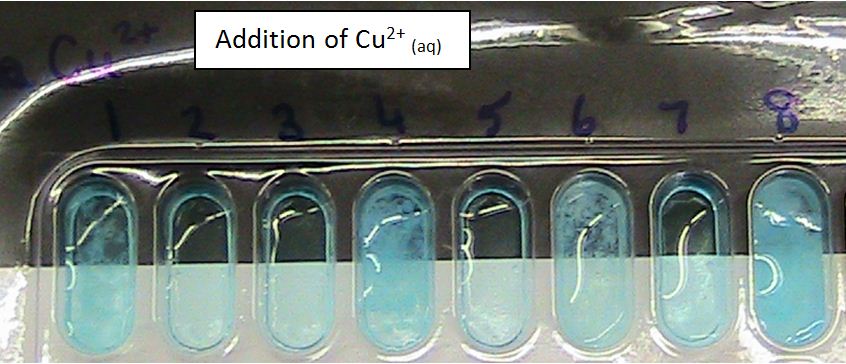
Here are some  photos of Experiment #18 - thank you to the photographer. Because of some 'interesting' results I combined images from this year and last year. Click on the images for a larger version.

The key is;
1)      OH-(aq)
2)      NO3-(aq)
3)      Cl-(aq)
4)      CO32- (aq)
5)      SO42- (aq)
6)      PO43- (aq) in neutral conditions
7)      PO43- (aq) in acidic conditions
8)      PO43- (aq) in basic conditions
9)      I- (aq)

PHOTO RESULTS


TABLE OF RESULTS
The full table of results can be downloaded at the link here. The file has two tabs, the first showing the correct results. The second tab showing our creativity and 'interesting' results. If nothing else these results demonstrate that old saying 'One person's sunshine is another persons sewerage'

AND - Here is another preview of Kingdom Rush 2 - not long now!


FEEDBACK

Worksheets

Generally well done. Tips:

b) When explaining flame tests it is important to say that when the atom absorb (heat) energy from the flame the electrons jump to higher orbitals, but when (they cool &) the electrons jump back to lower orbitals they emit light with specific energy (and thus colour) corresponding to the energy DIFFERENCE between the orbitals. These energy jumps, and thus colours, are unique to each element.

d) & e) ppm and unit conversions. A number of silly mistakes and errors here. REMEMBER that 1L = 1000g. Unit conversion is a skill that takes a fair bit of practise to master but once you get it – you have it forever.

i) be careful to answer the question. The studetn didn't know what the ions were so would have had to go through the whole cation test process - you just needed to indicate whatthye would observe along the way.

k) & l)  You need to revive excess and limiting reagent precipitation questions - particularly when asked to calculate concentrations of ions remaining in solution - you need to understand that any ion that ends up in the precipitate is no longer 'in solution'.

m) Ionic equations only include reacting ions (no spectator ions) and MUST include states. You have to be very careful to use our solubility tules when determining which ions form the precipitate.

n) & q) When explaining which ion must/must be in solution you have to give reasons. Questions n (a) and q needed some extra care in this regard. E.g. for n(a) it was insufficient to say it contained lead because it produces precipitates with sulfate, chloride and hydroxide ions. You needed to also why it COULDN’T be calcium – ie because it does NOT form a precipitate with chloride ions.

r) Again - remember that 1 mL = 1g, 1 L = 1000 g

BTW – Question n (c) and Question (o) had mistakes. Apologies.
n (c) should have said “…AND a precipitate with AgNO3.”
(o) should have had the last two columns identical with ppt for both hydroxide and sulfate but not chloride.

Summary

Generally VERY good

A) Safety – need to specify which are the heavy metals, their dangers, precaution and disposal strategies. Ditto for the acidic and basic chemicals. Finally you needed to specify why there was no flame test for lead. Don’t worry about the other chemicals.

B) Flow charts – States are need for all reactions. Take care with your charges on ions. Equations must be balanced.

C) Relevant Chemistry – make sure you are thorough in your explanation of the logic behind the choice of steps – focus on the broad reasons for choosing the steps for any sequence of precipitation testing – bit just the steps we used in our flowchart BUT you should include a specific example from our flowchart to illustrate the consequences of not testing in the correct order. eg when testing for cations if we had added sulfate first…

D) Some people were missing part of the table – please ensure the table is complete.

E) Sulfate precipitates with barium ions in acidic conditions but phosphate and carbonate wont (because carbonates react to form carbon dioxide in acidic conditions and phosphates are soluble in acidic conditions) BUT ALL THREE will precipitate with barium ions in neutral and basic conditions

F) Compare is a fairly low level verb – just similarities and differences – ie “Both are about the dangers of lead but…” then just a sentence comparing the differences of each issue style, purpose, accuracy, reliability. – 5 lines max? (but don’t forget the similarity – they are both about…)

G) This is a 1 page summary and 1 page flowchart report

H) Nitrates do NOT form precipitates. When you look at the formula for nitrate I want you to see NO3, ie NO precipitates


While marking this summary I was watching 'Giggle & Hoot' on ABC2 with my kids. This song really grabbed me. Probably the best song I have heard all year. On par with 'Life's a Happy Song' and 'Feel Inside - & Stuff Like That'.