Wednesday, 20 February 2013

Experiment #7 Feedback

Worksheet 16 and Compulsory Activities
A lot of misconceptions and ugly Chemistry appeared in this set of activities. Most can be squashed pretty easily – but it is going to mean that you have to do some practise to get incorrect habits/thoughts out of your minds – if you made the same mistake 20 times in this activity it is going to take about that many correct attempts to purge your brain of that incorrect approach. You want to make sure that your exam-subconscious-autopilot-brain mode has the correct instructions hardwired in or else…
But before I look at the most troublesome questions here is my Rant of the Week
1)      Electrode potentials MUST include the unit VOLTS. Without Volts (or at least a capital V) the answer is meaningless. Don’t let all that hard work calculating the answer be worth nought because you forgot to add a V at the end of your answer.
2)      Cu2+ and Cu+ are NOT the same thing. Use the correct cell potential!
Cu2+ + 2e- ® Cu (s)  Eo = 0.34V
Cu+ + e- ® Cu (s)  Eo = 0.52V
If you are ever doing a copper cell then it is mostly likely to be a 2+ solution and the reduction potential is 0.34V. Learn to love that number and learn to be wary of 0.52V.
3)      We learn these things for a reason: OIL RIG, RED CAT, ANGRY OX, ABC’s. At the very least check what you have written against these rules. e.g. you have written a half equation where electrons are being lost then (OIL RIG) that means it is oxidation and (ANGRY OX) that means it is at the anode which is –ve.
4)      USE THE REDUCTION POTENTIAL SHEET!. E.g., If you are told that there is a chlorine half cell then look at the data sheet to, not just figure out ABC’s but to also to figure out what reactions are possible. All of these examples below are wrong for many reasons, but that didn’t seem to stop anyone – you should be able to explain what is wrong with each one of these:
Cl2 ® Cl- + e-                       FAIL
½Cl2 ® Cl2 + e-                   WT FAIL
Cl- + e- ® Cl2                       SO FAIL
Cl- + e- ® Cl+                       SO VERY FAIL
Cl+ + e- ® ½ Cl2                  FAIL
½ Cl2 + e- ® Cl+                  EPIC FAIL
½ Cl2 ® Cl+ + e-                  FAIL

Q1) The dry cell is also known as the Leclanche cell (after the inventor of one of the first dry cell batteries). It is non rechargeable. The Lead acid battery used in cars IS rechargeable
Q2) Just do it – people must have thought this was part of Q3 as many skipped it (and it was easy)
Q4) When converting from half equations to a full cell equation you must make the electrons balance before you add the half equations together. But when converting a full equation into half equations you should simplify the half cell equations at the end.
Q5,6, 7, 8) Main issue is reading the question and doing all the things the question asked.
Q6) So very bad – see Rant point #4 above. Also in shorthand notation it should go: ion|related gas,Pt
E.g.  ||Cl- (aq)|Cl2(g),Pt
Q9) All pretty good except the overall cell equations. Just like any galvanic cell overall equation you: a) make the # of electrons the same in both half equations (i.e. for the dry cell you need to double that whole monkey-nuts equation)
b) simplify at the end (i.e. for the silver cell, the fact that electrolyte concentration stays the same means you should be able to cancel out the OH and H2O on both sides)
Q10) Just be careful - ‘ decreasing tendency’ means gong from the most likely to least likely
Q11) Similar to rant point 2 above. You need to be aware that there is a Fe2+/Fe half equation and a Fe2+/Fe3+ equations. Read the question carefully to know which one you need to use
Q13) To prove a reaction occurs ’as written’ means you need to prove the reaction is spontaneous. Spontaneous redox reactions give a positive Eo value. If you look at the equation provided, one reaction taking place is the oxidation of Iron(II) ions:  Fe2+ ® Fe3+ + e-. Take out the Fe2+ and Fe3+ terms from the equation and you are left with the other half equation. That is on the data sheet too. Just add the Fe2+ oxidation Eo to the Eo of the reduction process and see if it is spontaneous.
Q14) First - figure out which is oxidised and which is reduced from the equation, then just add the two potentials together (remembering to reverse the sign of the oxidation Eo)
Compulsory activities – need to be done. What was done was done well except for-
Q2i) Draw the cell diagram needed to measure the Ti|Ti2+ cell potential. To measure a standard cell potential you need to connect it to the standard reference electrode. This is in your notes - you need to look up what the standard electrode is AND its conditions. Yes, technically you can figure out the Ti-cell potential by connecting it to Mg or Ni etc etc as some people drew– but you need to be able to explain the use (and draw a picture of) the standard reference electrode.

Summary feedback
A)     We didn’t sand lead, we used a multimeter set to read voltage (not a voltmeter) & we used a new salt bridge for each new galvanic cell.
B)      Explain means give a reason – so in the Chemistry context, that means give a reason based on some Chemistry concept. E.g. it is not good enough to say ‘The cell needed a salt bridge’. You need to say ‘The cell needed a salt bridge because...’ where you go on to give a reason based on chemistry.
C)      While it is true that the greater difference in standard reduction potential, the greater the voltage (and you should say this) the Q refers you to the activity series so you should also relate the voltage to the relative reactivity of electrodes. Basically, the bigger difference in reactivity, the greater the difference in reduction potential and thus the greater the cell voltage.
D)     Standard conditions are 25oC and 1mol/L solutions (and gases at 100kPa). If these conditions are not met the Eo values for the cells will be different to the data sheet and thus the cell potential (and possibly anode and cathode as different cells are effected differently by changing conditions) will be different to that predicted by the sheet. Corrosion or damage to the electrode surface can also change the transport of ions to the surface and effect Eo values.
E)      You must mention storage (for proper disposal) all heavy metal solutions as part of your safety (i.e. do not tip down the sink)
F)      Beware of the Cu+ vs Cu2+ problem identified above
G)     Extracting data from graphs and tables is not just vital to extract data from standard potential tables to assess the validity of our experiment, it is also vital as that is how most numerical data is reported and scientists need to use this data to make calculations, judgements, conclusions and generalisations (i.e. about tends and patterns).
H)     You need to calculate the theoretical voltages for your table, but take care with cell voltages to use the correct values. Also, the theoretical value should always be positive (i.e. the theoretical value is the voltage for the spontaneous reaction that should occur. Spontaneous reactions happen automatically without net energy input so their Eo will always be positive).
I)        If you are gong to say ‘the salt bridge completes the circuit’ make sure you follow up with ‘by maintaining charge neutrality in the half cells’.
J)       KISS – Keep it simple students. Answer the question and don’t over explain. Some of the explanations we use in class are gross-oversimplifications of very complex processes. I use these so that you get a better understanding of the basic process (so you will more easily comprehend & remember the theory) – but they aren’t so good in written reports. Eg for Q3c – just say ‘Anions migrate to the …. through the …. while cations….
K)      In your results table, at minimum, you must include all the cells asterisked on the Excel table of result. Cu/Zn, Cu/Fe, Zn/Al, Al/Ni, Ni/Mg, Mg/Pb, Pb/Fe
L)       Your cell diagram needs to have the full cell reaction, both half cell reactions, salt bridge, flow of electrons and ions labelled, +, -, all chemical species labelled AND label the anolyte and catholyte.

While I was marking the Experiment summaries I was imagining what an awesome game it would be if they made a Game of Thrones version of Kingdom Rush (a similar concept to the 'Rio' version of 'Angry Birds' but bout a trillion times cooler).

I then had to have a soundtrack for my marking - cue the Youtube hits below. Some people are very talented and have too much time on their hands.


If this does not send shiver down your spine then you need to a) stop what ever it is you are doing b) read 'A Game of Thrones' and/or c) Watch season 1 of the TV series d) come back here and watch this clip again to feel that sense of the awesome that sends a shiver down your spine

And to think that when I was younger I used to think that playing the violin was uncool. I was so naive in 2012


Hmmm, despite the fact that this performer has more talent than I can possibly imagine and despite the awesome choice of music, I'm still not convinced that the flute is cool - but seriously are these things even flutes?...


While the Piano Guys have the definitive Harry Potter and Pirates of the Caribbean performance, I'm still searching for the ultimate Piano of Thrones. This is one of the best I've heard so far


These next two blew me away. I wish I was cool enough to play a guitar.

I admire cellists ability to persevere with their instrument even while knowing that nothing played on a cello will ever surpass Cello Wars.

Well, these two instruments aren't really to my taste but it takes all kinds...

And the award for the most creepily awkward performance goes to...

And now to some Game of Thrones songs for your next birthday party, bucks or hens night or wedding


And then to the most coldest black-hearted song ever

And if you have seen the TV series you will probably find this funny (I did). If you haven't watched it- well,  this clip won't make any sense and you will spoil the ending of season 1.

Actually I removed this because I thought about the content and then thought about who the audience is.
If you are determined to see it look up  (and watch in this order, noting that they are major spoilers)
Hitler and Ned
Hitler and Khal Drogo
Hitler and Blackwater

The last one  - even the name Hitler and... might be a spoiler

Monday, 18 February 2013

Experiment #8 & #9

I did some testing after class and discovered that beakers 5-7 and 9-10 were a bit mixed up

Real pH (labelled pH)

0.9 (1)

2.1 (2)

3.4 (3)

4.2 (4)

4.6 (7)

5.4 (5)

6.7 (6)

7.8 (8)

10 (10)

12.1 (9)

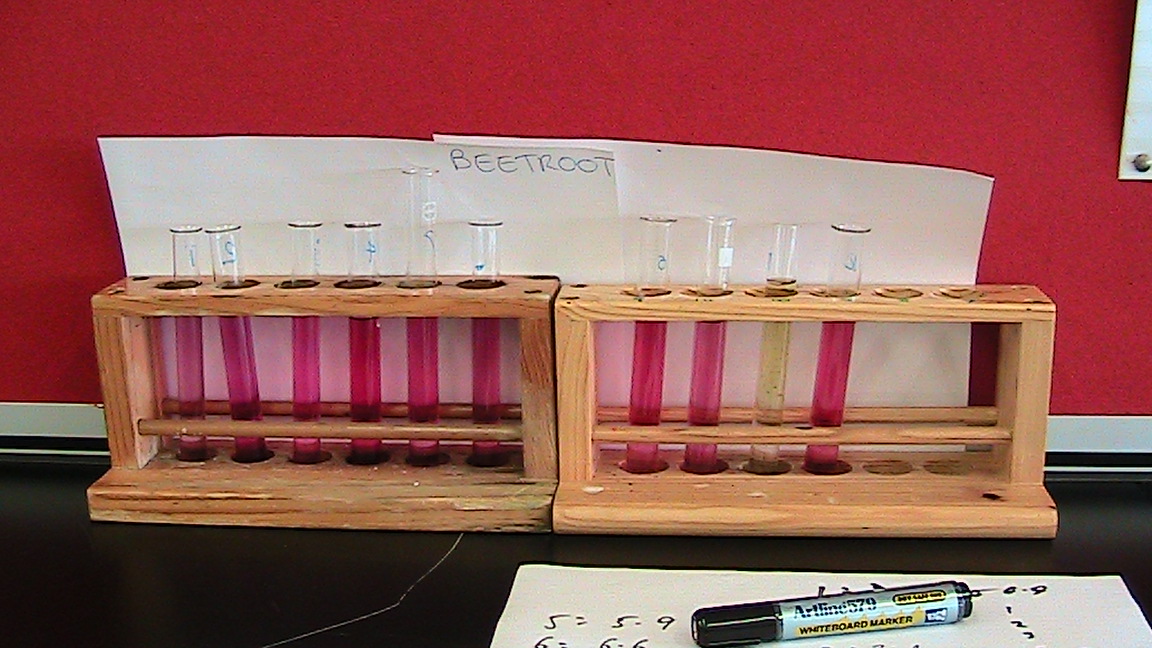
So I re-ordered the test tubes to show lowest to highest pH and re-took the photos  - shown below.

HINT - When assessing a natural indicator you have to ask - does it have distinct colour changes at certain pH's? Does the one colour give a consistent pH (or consecutive range of pH's)? Are the colours easy to interpret?

Photos show pH:  0.9,  2.1,  3.4,  4.2,  4.6,  5.4,  6.7,  7.8,  10,  12.1

BEETROOT (oops - I forgot to switch the 9 & 10 - yellow should be pH 10)


BLUEBERRY


RED CABBAGE


STRAWBERRY


BROMOTHYMOL BLUE


LITMUS


METHYL ORANGE


PHENOLPHTHALEIN


UNIVERSAL INDICATOR


Monday, 11 February 2013

Experiment #6 Feedback

WORKSHEET 14 FEEDBACK

Generally good responses but a disappointing amount of errors relating to oxidation #’s, oxidation and reduction.

Q1f) For positive metal ions the oxidation state is always equal to the charge on the ion. Such ions can range from +1 (eg Na+) to +8 (eg Mn8+).

Q3b) For any redox reaction the atoms and the charge must balance
Eg Ag+ (aq) + Pb (s) → Ag (s) + Pb2+ (aq) – the atoms are balanced but the charge is not (+1 in the

 reactants and +2 in the products)
If you think about the half equations for this reaction
Ag+ (aq) + e-→ Ag (s)
Pb (s) → Pb2+ (aq) ++ 2e-
It is clear that 2 silver reductions are needed for every lead oxidation, so the balanced equation is
2Ag+ (aq) + Pb (s) → 2Ag (s) + Pb2+ (aq) – now atoms and charge are balanced

Q5) writing ionic equations means that there should be no spectator ions. For 5c) according to metal displacement only the most unreactive metal ions will be reduced and form a solid. All other metal ions will end up in solution. Even still, do not include spectator ions in your equation

Q7) People who drew the grid typically got this correct. If you didn't and you got it wrong – DRAW THE GRID. If you did draw the grid and got it wrong it was typically because you i) didn't complete the grid for all species or ii) forgot what oxidation and reduction mean.

If the oxidation # increases it has been oxidised (ie, it is the reductant).
Eg if lead goes from 2+ to 4+, because 4>2 it has been oxidised.
Eg If chlorine goes from -3 to -1, because -1>-3 it has been oxidised (don’t forget the basics of the number line!)

If the oxidation number decreases (ie reduces) it has been reduced (ie, it is the oxidant).
Eg if manganese goes from +3 to +2, because +2 < +3 it has been reduced.
Eg If sulfur goes from +3 to -2, because -2 < +3 it has been reduced


AMAZING NEWS – Kingdom Rush 2 is coming out in Autumn!!!!!!! I AM SOOOO EXCITED!


SUMMARY FEEDBACK
Summaries were very good, just a few errors kept appearing.
A) Remember that we had to clean the electrodes between each different solution tested & at the end we tested the solution that gave a reading with two Cu electrodes and then two Zn electrodes.
B) You need to put the units for all measurements in the title-row of tables and you need to use units when referring to quantities in your text.
C) This experiment was about the BASIC requirements of a galvanic cell. Thee are only three things needed (four if you count each electrode separately). Even though the cells we analyse in problems have two different electrolytes and a salt bridge that is not really necessary (just easy to mathematically analyse). Also - remember that the electrolyte AND conducting path need to connect both electrodes.
D) Two different metals are needed so they have different reactivity. One tends to be oxidised more (it is a stronger reductant) than the other. This means there will be a potential (voltage) established between them that will allow current to flow when connected in a galvanic circuit.
E) You must mention that the flow of ions in the salt bridge maintains charge neutrality and allows the current to keep flowing (“completes the circuit” is OK but not sufficient).

F) Keep a) and b) simple – one is oxidation, one is reduction… For c) you have to think carefully
This is the galvanic cell we set up in the experiment

i.e. a zinc and copper electrode, separated by a salt bridge with an electrical contact (I’m going to refer to it as the experiment cell).
This is SIMILAR to the galvanic cell below.

Zinc is the anode because it is more reactive, copper the cathode, zinc gets oxidised at the anode (ie Zn ® Zn2+ + 2e-) & copper ions get reduced at the cathode (Cu2+ + 2e- ® Cu)
It is easy to assume that this is exactly what happens in our experiment cell, BUT -
While the Zinc in the experiment cell can be oxidised (so the anode reaction is the same) we have a problem at the cathode. This is because we have no copper ions in our experiment cell. So there must be some other cathode (reduction) reaction occurring.
This is where we have to ask yourself: “What else could be being reduced if not copper ions…?”
We do know that we have water in our salt bridge AND because it is exposed to air there will be a small amount of dissolved oxygen in the salt bridge too.
Hmmm…
Perhaps there is a reduction equation on the reduction potential list that has oxygen and water as the reactants in the reduction equation…
G) The results table needed a simple summary e.g. “The only cell that gave a reading ….”
H) You need to say that the more reactive metal (has a lower reduction potential &) will be oxidised, thus act as the anode which by definition has negative polarity. The less reactive metal will be the site of reduction…. Don’t forget to always apply OIL RIG, RED CAT and ANGRY OX to remember you polarities, sites of oxidation/reduction and which electrode gains/loses electrons.
I) I can no longer remember what the ‘I’ was supposed to indicate…If you figure it out please let me know.
J) Always be specific, don’t just say electrons (or ions) flow between electrodes, say exactly where they come from and go to (just like we never say ‘colour changed’ we say exactly what colour changed to what other colour).
K) The multimeter advantages are very simple. They relate to accuracy, ease of use and reduction in human error – just think to when you used the multimeter -  what made it better than trying to use a voltmeter?
L) Don’t forget that you need to include your original hypothesis.
 

 Luckily, Orcs Must Die

 is giving me my fix of tower defence (albeit first-person tower defence) until the sequel to the greatest game of all time, Kingdom Rush,  is released (seriously, click the image below to play it. Play it NOW!)


Saturday, 9 February 2013

9.4.4 HSC Question Feedback

This set of questions was a perfect example of why it is so important to be thorough with your Chemistry. Most people for most extended response questions lost a mark for a small error or because thye didn’t use an important Chemistry term in their answer. As a one off it does not really matter but across the whole paper it counts for approximately 25% of the available marks.
But generally the answers were very good and you should feel proud that you have completed so many HSC questions this early in the course. There are many students who wont even start doing this sort of work until stuvac. We have a whole 6 months to clarify any misconceptions, reinforce the depth of out understanding and fine-tune our exam technique.
 Specific feeback
2001
Q27) This was a tricky question to navigate because the source was unusual. It was a diagamatic graph. But because it was a graph it contained data and that measn you need to specifically refer to it. Eg “Ozone is mostly found in the stratosphere (up to 4.7ppm), while it is a maximum of 0.9ppm in the troposphere”. You then needed to describe its effects ‘nearby’ and ‘ip high’, which we did well BUT you need to sue the correct terms. Don’t call it the lower atmosphere  - call it the troposphere. Don’t say the ozone is in the upper atmosphere – say the stratosphere.

2002
Q25) b) This should have been an easy two marks but you need to be able to draw Lewis dot diagrams correctly (dots or lines – NOT both lines and dots for the bonds). You should always label the coordinate covalent bond.
Q25) c) Remember the dot next to the free radical. Also a phrase you need to work into ALL of your answers about CFC’s impacting ozone is “Cl free radicals catalyse ozone decomposition”.

2003
Q12) Because the graph showed the breakdown of one mole, you could just read off the graph C:F:Cl = 2:4:2 and remember wee don’t simplify covalent compounds (only ionic).

2004
Q12) We will cover this in the Acidic Environment topic
Q27) Answered really well but you need to refer to the data in the table. You need to describe CFC’s impacts (another opportunity to write: “Cl free radicals catalyse ozone decomposition”), refer to HCFC and HFC’s. You need to say the + and – of each and assess. which is most suitable. Also – 7 marks is a LOT – you MUST use chemical equations in all answers >3 marks
2006)
Q5) These isomer Q can be tricky – but I just draw myself some diagrams and eliminate the impossible multiple choice answers as I go.
Q28) The image shows a global analysis of ozone – thus they must have used a satellite system. BUT  - you MUST know that TOMS is not longer being used. They are using the OMPS (Ozone mapper profiler suite) on the AURA NPP Satellite. Finally –when it says discuss the ozone hole over Antarctica you must mention general depletion by CFC’s and the ozone hole that forms in Spring. But also NB that there have been some recent signs that the annual hole-size is not getting bigger.

2007
Q15) – I’ve said it enough times above ‘“Cl free radicals catalyse ozone decomposition”…
Q16) b) Once again an extended response question greater than three marks – You must use at least one balanced chemical equation (Eg ozone absorbing UV)

2008)
Q18) b) Apart from drawing a correct diagram of both, the other key things are to:
i)                    Note that ozone is bent and has a dipole, thus it is more soluble in water than oxygen (like dissolves like)
ii)                   Ozone greater size means it takes greater energy to vibrate – thus higher mpt and bpt
iii)                 Note that the single bond in ozone is easier to break then the double bond in oxygen – thus it is more reactive
It is very important to note that it is NOT the polarity or the coordinate covalent bond that makes ozone reactive. Once formed the coordinate covalent bond acts as a regular covalent bond.
Q21) A lot of students skipped this but really – it would have ten 30 seconds to look up the BOS and download a copy. I also wrote a description of the graph in the ‘graph space’ to help you out.
2009) – 2010)
Q12 & Q4 on the topic of naming – please don’t forget all the tricky rules (include hyphens, 2 – di, 4 = buta etc)

Friday, 8 February 2013

9.2.3 HSC Question Feedback


Generally very good.

I was impressed with your mathematical answers. The only concern here was converting between heat per gram and heat per mole (molar heat of combustion).
We have derived the equations for converting these in our notes but you don’t need to derive them I your answers, you can just rely on this equation:
Heat per mole = heat per gram x Molar mass
DcH = J/g x M  (and obviously this means J/g = DcH / M)
So the equations you need for heat of combustion are (and you should know most of these without needing to ‘memorise’ them):
q = mCDT
J/g = q/mfuel
DcH = q/nfuel
nfuel = mfuel/Mfuel
DcH = J/g x Mfuel

In the written responses the answers were generally thorough and demonstrated a dee understanding. One major point is that in 9.2.3 we are focussing on the ‘real’ world – ie humans ARE using glucose (from sugarcane) to make ethanol. This is different from 9.2.2 where the focus was on the POTENTIAL to convert cellulose into fuels (ethanol) and materials (ie via ethene) – ie not something that humans are actually doing. So when it comes to discussing ethanol you don’t need to start the process at cellulose (biomass) unless specifically asked.

Tips for specific questions

2002
Q1) Anything above 36oC starts to harm the yeast (its enzymes don’t function as efficiently)

2003
Q6) This is converting between J/g and DcH. However, you need to think: Is it easier to convert all four J/g data values to DcH to find the right one OR just convert the single DcH value to J/g to find the right one?...

2003
Q16) In this questions and ALL fermentation experiment questions – the focus is on i) Did you specify the correct chemicals (glucose, water, yeast) ii) was it an open container & iii) did you specify that you measured the mass before AND after fermenting (ie to measure mass loss). You do NOT need to go into detail about our airlock system UNLESS it asks about how you prevented oxygen entering and proved CO2 was produced. All you need to say (at the very most) is that “an airlock system was used to allow CO2 to escape but no air to enter”.

2004
Q25) Whenever you are given a graph (with numerical axes) or a table with numerical data YOU MUST REFER SPECIFICALLY TO THE DATA (ie numbers) in your answer. Eg “ethanol’s heat of combustion is 29.7 kJ/mol compared to octane’s 47.9 kJ/mol…”

2005
Q20) You should be able to do from Glucose to pure ethanol BUT do not start from cellulose (see notes above) – in addition the Q specified for the process in the flow chart and there is no cellulose in the flow chart.

2006
Q2) You need to know that concentrated sulfuric acid is a dehydrating agent (thus used for dehydration of ethanol into ethene). Dilute sulfuric acid is used for hydrating ethene into ethanol (this was the whole focus of our Experiment #3)

Q18) Just be careful to read the question and use your mole ratios correctly – many students were mixing up and finding masses of ethanol rather then glucose.

2007
Q24) a) If you are asked to plot a graph with molar mass or molecular weight as the axid you have to calculate and plot it correctly.

Q24) b) When determining values from a graph you should mark the value on your graph with lines to the axis.

2008

Q22) for this Q I would show the chemical reasons why ethanol is theoretically CO2 neutral. But then discuss the reasons why it does produce some net CO2, then I would MAKE A JUDGEMENT on the article. If you do not put a judgement on an assess or evaluate question you will lose 1-2 marks.

Q24) An excellent combination of moles J/g and DcH. I strongly recommend that you do this question again if you made a mistake. Knowing how to answer this question will greatly increase your understanding of these sort of calculations.

2009
Q17) If you read the question carefully you will see that you have to explain the similarities AND differences between water and ethanol solubility. You need to draw a diagram of both with the polarity labelled. You need to make a statement about like dissolves like. You need to state why both can dissolve polar and hydrogen-bonded substances. But then you need to say why ethanol can dissolve non-polar substances BUT WATER CANNOT – without this last statement you have not explained the differences.

Q20) a) When heat is lost to the surroundings the questions can be tricky. If calculating the heat of combustion this means that the heat you measured will be half what is produced so you need to double the calculated heat of combustion. But if calculating the amount of fuel that must be burned you need to double the theoretical amount of  fuel as half the heat is being lost. This is a question to do again for study.

Q20) b) A real sneaky question – most of the time the two ERRORS are heat loss and incomplete combustion BUT this question wanted two methods to reduce heat loss (only) – e insulate the container and move the flame as close as possible to the container.

2010
Q11) To answer this question you had to think – what chemical decolorises Br-water (alkene) & what chemical is dehydrated by sulfuric acid to make an alkene (alkanol)…

Q23) b) A nasty question. Similar to 2003 Q6 – I would convert the DcH value to a J/g to figure out which fuel. You should get 36 kJ/g which does not match any of the results. BUT this is the results of a STUDENTS experiment. Thus all the values are going to be UNDERESTIMATES. Thus the student would have always got a number LOWER than the theoretical value – ie lower then 36. So the correct sample must be…

2011
Q17) This is a DEMONSAUD Question - HINT - you have ben given q and DcH for propan-1-ol...what can you find the number of moles of...?

2012
Q30bii) Why might we add ethanol to a solution when trying to dissolve something in water?


Tuesday, 5 February 2013

9.2.2 HSC Question Feedback

Generally good but some serious misinterpretation of questions and misconceptions

1) We learned two main things in 9.2.2.

a) That biomass (cellulose) has the potential to be converted into glucose, then ethanol (which can be used as an alternative fuel) then ethene (which can be used as a raw material for chemicals). Many people ignored the fact that this cellulose derived ethene was a source of future chemicals

b) That biopolymers (derived from bacteria or biomass nutrients) – eg PHB have been developed over time (ie A. Eutrophus to GM E.coli to GM plants), are biodegradeable, have some limited applications but there are still many obstacles for them to replace petrochemical polymers

2) Biopolymers are not replacement fuels. They are replacement plastics. Technically burning wood (cellulose) is burning a biopolymer for energy but that is not the point of our studies in the Chemistry course.

3) Many students did not ANSWER THE QUESTION. If the question mentions a biopolymer you must talk about PHB, if it mentions biomass you must talk about cellulose, if it mentions current developments you must talk about PHB’s move from A. Eutrophus to GM E.coli to GM plants. If it mentions USES you must talk about specific applications. If it gives you a stimulus (eg a Blog quote) you MUST refer to it in your answer.

4) Make sure you include the CHEMISTRY. You need to demonstrate you are a better Chemistry students than the next person. If you only give a general answer (that any non-Chemistry trained person could write) you will only get (approx) half the available marks. That means write chemical equations, use chemical terms, whrever you can include descriptions of specific chemical compounds and processes.

2002 
Q18) Assess means +, - and judgement. This Q is about developments in a biopolymer thus you need to name the biopolymer (PHB) say how it was originally produced and how advances have increased production rates (ie A. Eutrophus to GM E.coli to GM plants). You should say its applications (and advantages eg biodegradable) and disadvantages ie limited uses and production and a judgement – ie developments have allowed more to be produced but applications are still limited (especially compared to petrochemical polymers)

2003 
Q20) You must note that cellulose if the main component of biomass. You must say how cellulose can be converted into ethanol and how this is a replacement fuel (ie eqn for combustion). You must say how ethanol can be converted to ethene and thus can replace chemicals (eqn good). You must say the advantages – ie renewable, less polluting and disadvantages (eg land use, expense, energy concerns) and then make a judgement (especially in light of crude oil ‘running out’)

2005 
Q18) Again the Q says development so a little on developments (ie making more and using more because we have gone from A. Eutrophus to GM E.coli to GM plants) You then need to say the advantages on the environment compared to traditional (ie renewable and biodegradable) and then the applications and impact on society – but don’t oversell – being used for razor handles etc has not ‘changed the world’ – you could use this as a negative and note its limitations (properties and production) have meant only limited applications. Then give a judgement (ie has potential…)

2006
Q6) we did this Q in class – don’t forget that for condensation polymerisation if you have (n) monomers you lose (n-1) water molecules …

2010 
Q30a) You must show the full equation (reactants and products – with correct formulae) and must label them as condensation or addition

Q30b) We have done this a number of times : to answer this question you need to describe the structure and link this to properties and link this to uses. Also when you name the polymer you must specify which monomer it comes from. VERY IMPORTANT – the bonds between chains are NOT covalent. They are intermolecular bonds and are usually weak dispersion bonds (but because the chains are so long these bonds are quite strong overall), but can be H-bonds when there are OH groups in the chains (eg cellulose).

You need to choose three different polymers but at least one needs to be from ethene and one from glucose.So, what polymer comes directly from glucose? Then I would choose two of the polymers that start with ethene - you could possibly get away with ldpe and hdpe but BOS might count them as the 'same' polymer...


2011
Q27) Be careful to read the Q – you had to include USES (2nd word of question) of a NAMED biopolymer (ie you had to say PHB) you had to mention the properties of both polymers (eg biodegradable vs non-biodegradable) and refer to the blog. Better answers noted polystyrenes properties and uses and noted that they were short term uses but because they were non-biodegradable they had specific impacts on living systems (ie relate to blog quote). They then contrasted this to PHB’s properties and applications and biodegradability noting the possibility of less environmental impact.


Monday, 4 February 2013

9.2.1 HSC Q Feedback

Generally very good and thorough answers.

Most lost marks were due to misreading the question, not fully interpreting the question or through not giving enough critical Chemistry details.

Tips on how to improve your answers are below as well as details about some misconceptions (critical that these are overcome ASAP).

2002
Q16c)
Equations for alkene reactions MUST be full structural equations (see here). BUT – be careful – you can use the completely summarised structure without drawing in all the C’s and H’s BUT if you draw in the carbons you must also draw in all the hydrogen. In addition it is very important to get states correct. Just ONE state missing or incorrect can lose you a mark. HINT: the cyclohexene is liquid, the bromine is aqueous, if you have 1,2-dibromocyclohexane as a product it is liquid (it cannot form H-bonds thus will not readily dissolve in water) BUT if you have 2-bromocyclohexanol as a product then it will be aqueous.

17) Be very careful to fully answer the question. Because it asked you to explain why the physical properties were similar but the chemical properties were different you had to do both. Both alkenes and alkanes are covalent molecular hydrocarbons thus they both have similar physical properties are non-conductors with low mpt and bpt. However, alkenes C=C double bond allows it to undergo addition reactions making them more chemically reactive then alkanes which only have single C-C bonds. NB the emphasis on the key chemistry facts: alkenes, C=C, reactive (addition) & alkanes, C-C, less reactive

2003
17b)
Describe means you need to give some chemical detail. Identifying it is addition polymerisation is one mark. For the full marks you need to specify the process of how addition polymerisation works, give an equation for the reaction and or the specific details of LDPE vs HDPE manufacture

17c) We went over the phrasing of this in our notes and Experiment #2 “The chaotic natur of addition polymerisation means activated chains of different length collide and terminate, thus resulting in a polymer with a distribution of molecular weights”

2004
17a)
If the question asks for ONE answer give one answer. Also if it asks for the common name and you give BOTH the common name and systematic name you will get zero as it shows that you do not know which is which. For the record (common/systematic): vinyl chloride / chloroethene & styrene / ethenylbenzene

17b) Because it said ‘discuss’ you need to give a little more then just a link between property and use. For the three marks: name the polymer (eg polystyrene), identify a property (when expanded it is tough and lightweight), link it to a use (thus used for packaging to protect goods), contrast to a different application (but when non –expanded it is clear and rigid so used for CD cases).

17c) i) READ THE QUESTION – draw the POLYMER (ie at least two repeating units). ii) polymers are so long that they form tangled chains with LOTS of interchain bonds. They are solids, not gases.

2005
16c)
Be specific when referring to the method. We used 2ml of each chemical ONLY for safety reasons. You must say that we used identical volumes (for validity) so say the exact amount “we used 2ml each of cyclohexene and cyclohexane”, is better and quicker than writing “we used equal volumes of of cyclohexene and cyclohexane”.

2006
20) A 7 mark question will likely be the biggest question in the paper. This is the sort of Q where the band 5’s are separated from the band 6’s. So in these Q you have to do whatever you can to distinguish your answer from the rest of the state. The Q had four main parts

i) Why ethylene is important – ie telling you must have an intro describing what ethylene is (structure) noting the double bond, noting it is reactive and can undergo addition reactions

ii) Describe new materials – ie NB that addition reactions can make a range of chemicals eg halogenated hydrocarbonds (refrigeration), but the big focus should be on addition polymerisation (ie making the monomers styrene, vinyl chloride) and the polymers PS, PVC , LDPE and HDPE

iii) Making fuels – we know that ethanol for fuels comes from fermentation BUT - do what the question asks – details how ethylene can be turned into ethanol

iv) Use equations (and because the Q specified equations they must be balanced HAVE states and there must be more then one)– eg hydration of ethylene to ethanol (with states and catalyst), addition polymerisation of ethylene into polyethylene.

2007
26) polyethylene and polystyrene come in two different structural types with different properties and applications. Thus link the structure to properties to uses for EACH of LDPE, HDPE, rigid PS and expanded PS = 4 marks. Misconception alert. The benzene ring makes the polystyrene chains lock together making non-expanded PS quite rigid. BUT when expanded the properties are dominated by the air bubbles in the structure (it is effectively a composite of air and PS). You do not need to know the explaantion for why the properties change so dramatically when expanded (beyond having the air make it less dense) but it is important that you understand that the air does NOT act as a plasticiser and make the chains slide easier.

2008
16b)
You had to mention the three chemicals you used and the alkene and alkane had to be corresponding (eg cyclohexene and cyclohexane), you had to say what you would OBSERVE to distinguish them (ie in cyclohexene the colour of the bromine water went brown to clear) and you had to include a fully balanced, structural equation with correct states (see 2002 Q16c above).

2009
6) Read the question carefully. Unsaturated means it has double (or triple bonds) and thus there will be an ADDITION reaction!

19) Read the question i) ‘physical and chemical processes’ & ii) ‘from a raw material’. Raw material means something found in nature. Some interpreted this to mean cellulose and they did the whole cellulose to glucose to ethanol to ethylene description – this is fine but the problem is that we don’t make ethylene that way (yet). So you had to start from CRUDE OIL. From there you had to describe each of these processes i) fractional distillation (P), ii) cracking (C), iii) addition polymerisation (C), iv) shaping/moulding into a bottle (P). NB LDPE & HDPE are thermoplastics so they can be molten and shaped. BIG MARKS = USE AT LEAST ONE CHEMICAL EQUATION

2010
Q24b)
Whenever you get a question about distinguishing alkenes vs. alkanes you should ALWAYS use the Br water experiment. Why not bubble the gas through Br water and if it turns clear that means some ethylene is still present. If it stays brown that means only ethane is present….

2011
1)
READ THE QUESTION CAREFULLY!

Wednesday, 30 January 2013

Intro to Radioactivity

Welcome back everyone.

Here is a nice little video from TED ED - should watch before Week 2


This video below also caught m eye on TED ED. It is pretty amazing that a parasite can actually CONTROL THE BRAIN of its host and make it do its bidding!!!

But while the video below is great this list is what blew me away - the degree of control that parasites can have over their hosts is incredible. My favorite is the fungus that controls the minds of ants...

Monday, 24 December 2012

Wednesday, 19 December 2012

9.4.4 Feedback


PART 1  - THE ATMOSPHERE


1)   9.4.4.1.1 Describe the composition and layered structure of the atmosphere

 (A) Of all the ozone in the atmosphere, 10% is found in the troposphere. This is not the same as saying ‘10% of the troposphere is ozone’ (it would be hard to squeeze in that 10% considering that ~80% of the troposphere is N2 and ~20% is O2)

(P) Be careful with your diagrams, the layers of the atmosphere get thicker (in km) as you head toward space – your diagrams don’t have to be to scale but they should reflect this. Also, make sure the ozone layer is IN the stratosphere, it does not take up the whole stratosphere.

2)    9.4.4.1.2  Identify the main pollutants found in the lower atmosphere and their sources


3)     9.4.4.1.3   Describe ozone as a molecule able to act both as an upper atmosphere UV radiation shield and a lower atmosphere pollutant

(Q) Always include the ● for free radicals (even O●)

(R) When discussing the dangers of UV, it is important to mention both its effect on plant photosynthesis and on animal cells (e.g. sunburn, DNA damage, skin cancer).

PART 2 – THE OZONE MOLECULE


4)   9.4.4.1.4  Describe the formation of a coordinate covalent bond

(B) Remember from yr 11 – All atoms ‘want’ to get a ‘full outer shell’ of electrons (ie a ‘noble gas configuration’). Non metals can obtain this stable full outer shell by gaining electrons or by sharing them with other non-metals (ie forming a covalent bond).

(C) Always draw ozone with its bent shape. It is an important structural feature. It is also important to draw all the electrons in their correct positions around each atom.

5)     9.4.4.1.5   Demonstrate the formation of coordinate covalent bonds using Lewis electron dot structures

(S) Be careful, a single covalent bond has a PAIR of electrons being shared (ie one from each atom). This means there are four shared electrons in an…

(X) Lewis dot diagrams need the square brackets [ ] around ions with the charge specified e.g. a sodium ion is [Na]+. For clarity it can help to draw the electrons for each atom with different symbols (eg x, o, ●) and it is advisable to label the coordinate covalent bond. See here for the correct way to illustrate the fomation of a polyatomic ion with a coordinate covalent bond).

6) 9.4.4.1.6     Compare the properties of the oxygen allotropes O2 and O3 and account for them on the basis of molecular structure and bonding

(D) It is vital to define all Chemistry terms properly. You need to know the correct (thorough) definition of allotrope.

(E) There is nothing wrong with putting the actual values for O2 and O3 desnity, solubility, mpt and bpt in your table but you DO NOT need to know these values – just that O3 has higher values than O2.

(F) O2 and O3 have a low mpt BECAUSE they are covalent molecular ie they HAVE have weak intermolecular bonds which require LITTLE energy to break allowing the molecules to separate. ALSO - because thye have low bpt they are gases - because they are gases they have low density.

(G) You need to explain the differences in mpt, bpt and water solubility for O2 and O3. Firstly, O3 is slightly polar (ie has dipole-dipole intermolecular bonding as well as weak dispersion) due to the uneven distribution of electrons in the molecule – thus it forms slightly stronger bonds with water molecules (a polar solvent, like dissolves like) and thus has higher solubility). This stronger intermolecular bonding, AND because it is a larger molecule requiring more energy to vibrate, means it takes more energy to separate the molecules giving it a higher mpt and bpt.

(H) The single covalent bond in ozone is easier (take less energy) to break than the O=O double bond. Thus O2 which only has the O=O double bond is less reactive then O3.

(T) It is vital to know the difference between intermolecular and intramolecular bonds. Clearly, these terms only apply to covalent molecular substances (the only substances that are ‘molecules’, not ‘lattices’) – so the strong intramolecular bonds are the covalent bonds between atoms and the intermolecular bonds are the weaker forces (bond) between molecules (eg hydrogen bonding… & …).

(Y) Oxygen free radicals don't have a measured bpt and mpt etc because to measure these values you need to have a number of them together - but as soon as you out these reactive molecules together they react to form O2 preventing the properties of O● being measured.

(Z) To compare the strucutre of O●, O2 and O3 you need to detail their # atoms, intermolecular bonds, types of intramolecular bonds (v. imp!) and draw a Lewis dot diagram. NB - sometimes you will see ozone drawn with two single bonds and a 'dotted arch'. The dotted arch is called a ‘resonance bond’ – we don’t worry about that in yr 12 HSC Chem – just draw it with the bent shape and with ONE double bond and ONE single coordinate covalent bond.


7)     9.4.4.1.7   Compare the properties of the gaseous forms of oxygen and the oxygen free radical


PART 3 – CHLOROFLUOROCARBONS & IMPACT


9)     9.4.4.1.8      Identify the origins of chlorofluorocarbons (CFCs) and halons in the atmosphere


10)      9.4.4.1.10   Discuss the problems associated with the use of CFCs and assess the effectiveness of steps taken to alleviate these problems

(I) The ozone hole is a seasonal (Spring) event in the Antarctic where there is rapid depletion of O3, forming the ozone ‘hole'.** Ozone depletion refers to the general decrease is global O3 concentrations that have occurred over the last 40 years.
** NB when the ozone hole 'breaks up' in late Spring, severly ozone depleted air can spread north to Southern Australia.

(J) The cold dark Antarctic winter results in ‘ice’ crystals forming in the stratosphere. These ice crystals catalyse the reaction between chlorine nitrate and hydrogen chloride to form hydrogen nitrate and chlorine gas. It is this chlorine gas that decomposes to produce the chlorine free radicals when the sunlight returns in spring (the large amount of Cl●  results in rapid ozone depletion and the ozone hole)

(U) You must mention (along with your series of equations) that the Cl● CATALYSES ozone destruction (ie it takes part in the reaction, providing a reaction path with low activation energy and thus increasing the rate of reaction, but it is reformed and not consumed in the reaction)

11)    9.4.4.2.1     Present information from secondary sources to write the equations to show the reactions involving CFCs and ozone to demonstrate the removal of ozone from the atmosphere


12)      9.4.4.1.11    Analyse the information available that indicates changes in atmospheric ozone concentrations, describe the changes observed and explain how this information was obtained

(K) Dobson spectrometers monitor a wavelength that O3 does and a wavelength that O3 does not absorb – by comparing their relative intensities the concentration of O3 can be calculated. Similarly satellite systems monitor wavelength of light that ozone does and does not scatter to determine O3 concentrations. There is a nifty little video about this here: http://www.youtube.com/watch?v=BCAQR-4ue0U

(L) You need to know at least one advantages and one disadvantage of balloons, Dobson spectrometers and satellite-based spectrometers. Also: Nimbus, Aura and Suomi-NPP are satellites, TOMS, AURA and OMPS are the ozone monitoring instruments they carried (respectively). The one being used now is OMPS. If you talk about TOMS you sound outdated and will be penalised for not using reliable (ie current) resources). There is a nifty little video about this here: http://www.youtube.com/watch?v=BCAQR-4ue0U

13)    9.4.4.2.3     Present information from secondary sources to identify alternative chemicals used to replace CFCs and evaluate the effectiveness of their use as a replacement for CFCs

(M) When comparing CFC’s, HCFC’s and HFC’s:

a) Say what atoms they contain

b) Note that Cl is the halogen that damages ozone

c) NB that HCFC’s decompose in the troposphere (so little reaches the stratosphere) but NB they have some ODP (and define this the first time you use it) because thye still contain Cl

d) NB that HFC’s have no ODP because…

(N) When writing a criteria, be smart and be specific. Rather then saying that “One criteria to be examined is the ODP”. Say “To be a successful replacement, the chemical must have low to no ODP to overcome the problems produced by CFC’s” – after that, if you say that HFC’s have no ODP you have addressed the criteria and it is clear that HFC’s are a good option.

(O) When assessing the Montreal protocol, you should consider the fact that it has been followed worldwide, and that CFC’s use and productions rates have dropped and that Cl concentration in the atmosphere has started decreasing and that O3 concentrations are currently relatively steady.

(V) When you state that CFC’s continue to be released into the atmosphere  despite the Montreal Protocol (and thus the recovery will be slow), you need to specify that this is from old disposed CFC’s containing equipment in landfill

14) EXTRA – you DO need to know ppm and ppb in the HSC course

(W) – Oops, the answer to (a) should be 0.2 GRAMS, and (d) should be 0.013 ppb (read the Q Dr Blurg!)